It’s Time to Love Yourself in a Swimsuit

“You may not return this item if the hygiene strip has been removed”. 

The hygiene strip, dear reader, was indeed detached from one of the $100 swim suits I had ordered to try on. The strip stuck to the underwear I wore to shimmy into the pricey suits and fluttered to the bathroom floor as I peeled one of the candidates from my body. I tried to smooth the tacky strip back into place, but the dog hair and lint it had accumulated on its brief brush with our tile made reattachment impossible. 

That night, I stared at the ceiling rehearsing the speech I would give to the Customer Service rep first thing in the morning. “I promise I was wearing underwear! I know how bathing suit shopping works! I didn’t mean for it to come off or land in a swirl of hound dog dander and become unusable! I don’t think it was very sticky to begin with, if I’m perfectly honest. I need to get a refund for this suit. My boobs looked like sad beanbags in it, and it gave me one of those weird belly button ghost shadows in the middle. I cannot keep it. Please give me my money back.”

When I rolled out of bed, I called Customer Service. The 800 number opened for business at 7AM Eastern Time, so I spoke to Cheryl on the phone and told her my hygiene strip sob story before I even made coffee, before I had said more than three words to my kid. I could hear her keyboard clacking as she listened. “I made a note on your order that the hygiene strip on the navy blue suit was not very sticky and it came off during try-on and could not be reattached. I’ve made a note to please accept your return and process a refund.” I thanked her profusely and assured her that I had, in fact, found My Dream Suit from among the four contenders. “I’m so glad you found one that worked out for you! Enjoy!”

For the first time in my adult life, I think I actually WILL enjoy wearing a bathing suit. I found my dream suit, and I am still in shock. I haven’t taken it for a real test drive at the beach or the pool yet, but my daughter clapped and squealed “You look FAB-U-LOUS, mommy!” and Les gave me a thumbs up, followed by “Yeah! You look great!” when I stepped out of the bathroom wrapped in brilliant purple. 
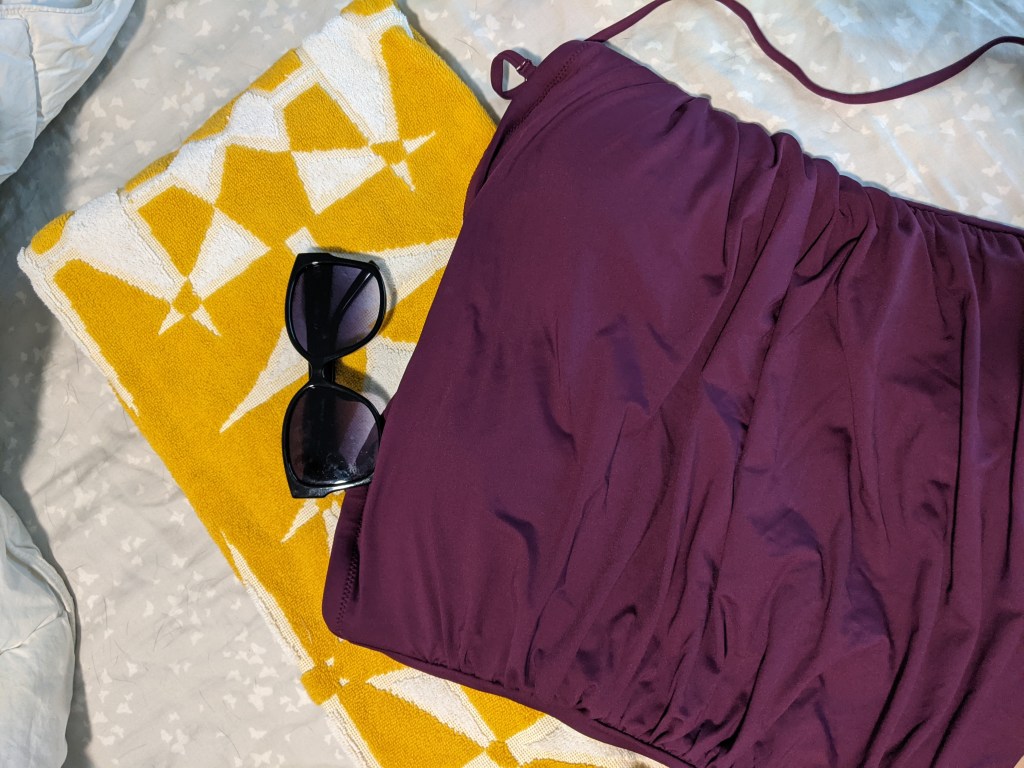
It has a removeable halter strap, but I didn’t need it!

“Do I look $98 great? Because that’s how much this suit costs.” He looked a little shocked, but replied that if I felt good in it, and I knew I would wear it, I should keep it. He could see the look of genuine pleasure and confidence on my face. I clipped the tag immediately and yanked the hygiene strip from the crotch. The suit is now nestled like a treasure in my dresser drawer, just waiting for its debut at the lakefront or the pool. 

I’ve never spent an adult amount of money on a bathing suit. Throw me whatever Target clearance rack mismatched tankini pieces you have handy. But this year – THIS YEAR – I vowed to buy a bathing suit that fits my actual body and that cost more than $29.99. I took inventory of my summer wardrobe a few weeks ago and felt the elastic of one of my old swimsuits disintegrate within the seams as I attempted to try it on. I moved on to the tankini I bought two years ago. That suit still has functional elastic and technically, it still fits. It fits in the aggressively snug manner of a bathing suit that should be at least a half-size bigger. 

Did I really need a new bathing suit? A reasonable question. Historically, I haven’t done a lot of swimming or poolside lounging. But there’s a lot of pressure on this summer to make up for the utter garbage of last year’s cabin fever COVID summer. I have been imagining steamy afternoons at our favorite northside beach and the neighborhood pool with my kiddo. I’ve even entertained the idea of a road trip to my in-laws’ vacation condo in Florida, visualizing myself draped across an oversized pool float with a margarita in each hand. 

I decided not to let Snug Suit get in the way of my water fun summer dreams. I did what any rational person would do and I ordered eight bathing suits. Four bathing suits in different sizes and styles from a brand that I love but could never gulp down the price tag, and four from more modestly priced brands. I assured Les that I would only be keeping one of the eight, if any, and that I would return the rest before the credit card bill came due. And that is how I found myself with hundreds of dollars of nylon and spandex in boxes in my bedroom. 

As I clicked “Add to Cart”, I asked myself what it could be like to find a suit that I really love. What if I found a suit that sparked joy, even if it was not the suit that made my body look the smallest, or had the strongest spandex forcefield across the midsection to constrict all that wayward flesh into a more acceptable silhouette? Would it even be possible to love a suit that didn’t deliver a body shrinkage illusion? I was determined to find out. “It’s research. You know, for my writing!” I chirped as I eagerly jabbed “Checkout.”

First, I ordered four tankinis. I believed that dark colored tummy-hiding tankinis with sturdy push-or-pull up bras were my best option. I had tried those “Build Your Perfect Suit” combinations where you buy whatever top and whatever bottoms you like, but the results were just…awful. I’m trying to think of a more writerly way to say it. One brand offered “Tummy Control” tops, so of course I tried one. Go grab a fresh tube of toothpaste, take off the cap, and squeeze the tube from the dead center. That’s what a tummy control tankini top does to your midsection – it just rearranges the plush. And also, you can’t breathe. The other tops were either billowy and unflattering or too tight and unflattering. The shorty-style bottoms were too tight in the waist and the material was somehow scratchy? Positive visualization is important for stressful situations, so I visualized feeding all four of these tankinis into a wood chipper. 

After the tankini debacle, I went wild with hope and desperation and flew to the posher brand’s website and added four chic retro-vibe one piece numbers to my cart. I haven’t worn a one piece since my 20s. One piece suits, I believed, were only for the athletically svelte, not for those of us with bellies or bosoms in need of support.

A few days later, the box with the splurgey suits appeared on my doorstep. I sprinted to the bathroom and chopped open the box with some rusty old manicure scissors I found in the vanity drawer. I grabbed my top-pick suit and tore it from the plastic wrap. This was the suit I was just SURE was going to be the winner. Feminine, some fashionable ruching that didn’t scream “BELLY CAMOUFLAGE”, pretty pattern, and the same general cut I remember wearing when I last wore a one piece suit 15 years ago. 

I slid into that suit and instantly realized the difference between a $30 bathing suit and a $100 bathing suit. The material was buttery soft and not one inch of that suit pinched or smashed or strangled. No sagging or riding in the butt. It was a beautiful suit that, sadly, I had ordered in the wrong size AND had failed to appreciate the plunging drama of the neckline. I could have exchanged it for the proper size, if not for the fact that my boobs needed a lot more than an elegant nod to support, and definitely cannot be trusted around a v-neck that stops at the bottom of my sternum. Back into the wrapper. 

I grabbed the next suit, which had glowing reviews online from other women my size and build. Thank you, swimsuit reviewers of the internet, for being forthright with your size and measurements so we can all benefit from hive-mind consensus over whether an article of clothing is realistic on a size 12/14 middle age body when the brand model is a willowy 20-something. I started to step into this simple but feminine navy blue suit and immediately noticed that the hygiene strip was crunched and suspicious-looking. I was wearing my undies for this try-on sesh anyway, because I don’t trust anything that comes in contact with another person’s business, hygiene strip or no hygiene strip. I smoothed the strip and carried on with the try-on. No bust support, nothing in the midsection or other details to endear it to me. Not a winner. I peeled out of the suit and gasped in horror as the plastic strip fluttered to the floor. In that moment of fashion frenzy the lost strip was Future Jill’s problem, because I had two more suits to try. 

I had ordered the same suit in two sizes, each in a different color. The reviews for this ruched bandeau-style suit were too good to be true. I don’t wear strapless ANYTHING. I need straps – the thicker the better – to keep the girls hoisted into position and to avoid wardrobe malfunctions. But virtually every woman who reviewed this suit said a version of “Stop wondering if this suit will work for you and just buy the damn thing. IT WILL WORK.” It’s listed as a Best Seller on the brand’s site. It comes in pretty colors, and both of my preferred sizes were in stock. I bought a bright purple in my hopeful size and a dark green in my often-more-flattering larger size. 

When I put on that purple suit, I felt a strange sensation ripple through me. There, in the mirror, was my body in a bright bathing suit. A beautiful, flattering color. My bust looked spectacular – well supported, and shockingly, not at all like an indecency waiting to happen. I jumped up and down. Everything stayed in place. The silky soft ruched fabric created a lovely blurring effect throughout the torso without trying too hard for an optical illusion. No compression, no hidden corset panels. Other suits may have been better at visually slimming my waistline, but none of them made me feel so eager for a pool day. I felt beautiful in this suit, in my own body. Bright and happy and confident. I didn’t even take the dark green suit out of the wrapper. I just bolted into the bedroom where my husband and daughter awaited my fashion show and did a twirl.

I know that $98 is a lot to spend on a suit, and it’s not in everyone’s budget. It’s probably not really in my budget, to be honest. I don’t think you need to spend that much money to find the perfect suit for you, but try some shapes and styles that you’ve never tried before. And COLOR! For the love of all that is soft and fluffy, at least TRY a color other than black. You never know. You may find yourself naming your new suit (Iris) and tucking it into bed in your dresser drawer with a sigh of disbelief. For the first time in forever, I can’t wait to wear a bathing suit in public. And there’s not a “tummy control” panel in sight.
Hope and Death

My daughter and I watched a delicate little field mouse draw its last breath on our front stoop yesterday afternoon. Our hound dog’s face had just emerged triumphantly from the viney ground cover that lines our sidewalk and dropped the poor twitching creature from her mouth when I screamed “Daisy! No!”

My kiddo held hope for a few moments that the mouse was OK. “Maybe it just needs to rest a minute, mommy. It’s probably just scared.” It died as we hovered over it, trying to revive it with our wishes and whispered encouragement.

I buried it in the soft earth next to our garage. My daughter originally wanted to leave it for a scavenger, like they do when they discover a dead animal at her outdoor Kindergarten. Her school sprawls across 42 acres that includes wondrous wooded knolls, a natural pond, a small stream, dense underbrush, and wide open fields – a thriving suburban ecosystem. 

The first time the Forest Kindergarteners came upon a dead animal this year, her teacher sent an email to all the parents letting them know that they had found a dead bird, and that some of the children had decided to fashion a grave for it using rocks and twigs and leaves to make a circle around its body, and to say goodbye to it. “We left the bird for a creature who would make it a meal, and talked a little about the circle of life”. She attached a photo of children, including my kiddo, gingerly placing pebbles in a reverent ring around the body of the chestnut colored nuthatch.

When I buried the field mouse, my daughter confidently assured me that “It will be safe and cozy there in the dirt. Nothing can eat it.” I reminded her that, in fact, worms and other small creatures that live in the soil will eat it. This seemed to remind her of something her teacher told the class; “Oh yeah. That’s right. Dead things get eaten, too.”

She was calm and matter of fact about the mouse throughout this funeral rite, but when she told my husband, Les, about it later, she teared up a little bit. “It was so CUTE, daddy! So tiny and furry!”. She had also silently wept when I told her a few days ago that Les had squashed a big spider in the mudroom. “Why did he kill it, though? Why didn’t he take it outside? Why did he kill a living thing?”. Hot tears slid down her cheeks in genuine anguish.

We’ve talked about death regularly since our beloved Chihuahua mix died last summer. We told her that AuggieDoggie is with God, and that we’ll see him again some day. I believe that some version of that statement is true. We told her our current beliefs about heaven, and resurrection, and that God will make a new Earth someday and all the people and animals will be together again. Some days I waffle on how confident I am about that, but I don’t tell her about my doubts. I choose to project the most hopeful version of all the things I’ve believed and wrestled with over the last several years. 

I wonder whether she’s regaling her classmates with musings on eternity, as she often does with us.

“When God brings us back to life on the new Earth, we can jump from high up and not get hurt! And I won’t need a flu shot, because we can’t get sick!”

“On the new Earth, I bet the dinosaurs will have to all be in one place so they don’t try to eat us.”

“Auggie and Daisy will play together someday when we all die and come back to Earth!”

In the car on the way to school last week, I told her that my grandpa was missing a finger. His pinky finger had gotten cut off in an accident, and the doctors couldn’t reattach it. 

“When your grandpa comes back to life on the new Earth, will he have all his fingers?”

I’ve found a lot of comfort in her unmuddied focus on the wholeness and togetherness of the afterlife. She doesn’t seem terribly ruffled by thinking or talking about death. Her curiosity and open-hearted approach to these discussions feels healing to me. I spent at least 30 years terrified of death. 

In July, it will be 20 years since my dad died of complications from Type 1 Diabetes. He was 51 – just 8 years older than I am now. I was 23 when I got the call at 2:30 am that the disease that had ravaged his body since he was five years old had overtaken him. 

Growing up with a parent with a debilitating chronic illness can really do a number on one’s mental health. I didn’t realize just how sick he was, or how perilous every hospital stay really was, until I was in middle school. Once the reality of the situation hit home, I spent the next 11 years worried every day that that day would be the day that he died. Or worse! That somehow my mom would die before my dad, and we three kids would be left to care for him.

But don’t you worry, I also had a thick layer of Fear of Hell ladled on top of all that Fear of Dad Dying. And the Fear of Hell started much earlier. Because on top of the fear that my mom or dad could drop dead at any minute, I was also very much afraid that if I should be the one to die, I would almost certainly go directly to h-e-double-hockey-sticks. Why? Because according to the Southern Baptist preacher who yelled all the chapel sermons at the sleep-away church camp I attended with my cousin the summer after third grade, I hadn’t been properly baptized. One way ticket to a burning lake of fire, obviously.

I’m not going to church-bash here. I was raised in a church that did not adhere to the Turn or Burn agitation of some Protestant denominations. But when you’re a kid, and you have been raised since birth to revere clergy and to believe that every word of the Bible is literally true, hearing about how I would be physically tortured for all eternity when I died kept me up at night every night for three years. What if that guy was right, and my parents and pastor were wrong? That’s a story for another essay. 

Just know that I haven’t always been so hopeful or open-hearted about death. I’m not Protestant anymore, and I no longer believe in literal hell. My husband and I converted to Eastern Orthodoxy 6 years ago. One of the most healing and mind-blowing things I learned since becoming Orthodox is that the Eastern church has never embraced a doctrine of literal hell or eternal torment. The early church, and for millenia afterwards, the Eastern church, has embraced the mystery of God’s justice and perfect goodness with both arms around the assurance that we worship a Good God, who loves every single one of us. For eternity.

That’s what we teach our daughter. 

It’s not easy for me to talk about death with my kiddo, but it has gotten easier. Once you are not trying to tightrope across a narrative that the all-loving God who created you and pandas and tree peonies is the same God who would damn most humans to hell, the cognitive dissonance tumbles away in the wind. So does the fear. 

I can be more honest about what I believe, and what I don’t know about death and what happens after we die. None of us really knows, of course. But I have spent more time thinking about it than most people I know. My mom died eight years after my dad, when I was 31. We talk about Grandma Betty and Grandpa Scott regularly, and my daughter knows that they both were very sick when they died. 

“Do you think your mom and dad will like me when I meet them after I die?”

“Your mom and dad died when they were very sick. But you aren’t going to get sick and die. At least until you are very old and I am a grownup.”

“People don’t get to choose when to die, right? There’s no way for a person to make themselves die, right?” she asked one morning in the car. “God decides when someone will die.” That’s all I could scramble together in that moment, three minutes from turning into her school drop off line. 

“When your mom died, did you ever wish that you could die with her so you wouldn’t have to miss her so much?”

“I didn’t want to die with her. There were so many things I still wanted to do! I wanted to get married, and get a dog, and have a house, and travel and have adventures. I knew I would really, really miss her. But I also know I will see her again, and there are a lot of things I still wanted to do on this Earth, in this life.”

“Yeah. Me too. I don’t think I would want to die when you die, mom. But I think I would miss you too much.” 

“I miss my mom so, so much. And my dad. But I have you, and your dad, and my friends, and Daisy, and so many good and wonderful things here. I’m glad to be here with you, right now.”

“Me too, mom. Just don’t die until you are very, very old.”

“Deal. I’ll do my best.”

Confronting Fat Phobia

I don’t want my daughter to inherit what I used to call “food issues”. I now know those food issues are more honestly called Fat Phobia. Despite all the thinking and reading I have done about body acceptance/neutrality over the last five years or so, I’ve only started working to eradicate my deep, visceral fear of gaining weight and getting fat. 

I used to think I could side-step the fat phobia work by refocusing my mental energy on intuitive eating, or exercise for muscle tone, or by repeating a mantra with a clenched fake smile: “This is just how my body is, and that’s A-OK.” 

The Fake It Til You Make It approach hasn’t worked. It turns out, shame and fear aren’t very effective for transformation. Looking at the problem honestly is crucial, and I’ve avoided that step for decades. I recognize now, finally, that I don’t just fear becoming fat. I fear fat people. 

My fat phobia doesn’t just impact me and now my daughter. It bleeds into the world and stains my interactions and relationships with people of all sizes. The way I silently compare myself to other women. My envy of slim people. The fear that sizzles on my skin when I see a person with a large body.

This is the ugly root of diet culture, isn’t it? We’re not talking about this. I am certainly not admitting out loud to anyone that I’m afraid of fat – my own or anyone else’s. No, no, I’m concerned for my HEALTH, you see. I want to be HEALTHY. I want to live a long, disease free life. I don’t want to get diabetes or heart disease or cancer. The health anxiety is real, too. It’s all pureed together with my fat phobia, orthorexia, classism, racism, ableism, internalized sexism. All of it. 

In the last 10 years or so, two of my friends have confronted me about my fat phobia and how it has hurt them, and impacted our relationship. 

“It feels like you think that if you just talk enough crap about your own weight, or complain enough about your body, or talk enough about your diet to me, that your fat phobia will somehow rub off on me and I’ll start dieting and lose weight. That’s not how it works. And it sucks that you would think that.” 

Another friend said; “I do think you care about me, but it’s obvious that my body repulses you, and you pity me.”

Both of these comments occurred in context, not out of the blue. Neither friend just blurted out “You are an asshole and a bad friend”, though they would have been correct if they had. Both times, I sputtered for any kind of response. I admitted that they were right and apologized, and both times they offered me more grace than I deserved. Miraculously, I am still friends with these amazing humans. I’m humbled and thankful that they would confront me with the truth and give me an opportunity to repent and repair. But even with the fresh smack of being confronted with my own ugliness, I’m still working on my fat phobia ten years later. 

This is my continual, daily work. If I don’t tackle my fat phobia, I will reinforce society’s utter disdain for fat people to my daughter. 

This morning, I read an essay by Kimberly Dark called Taking the Shame Out of Fat Shaming. She describes an incident in which a 5 year old called her fat. Her reply:

“Hey, Taylor, did you just call me fat?” And he turned to me, with a little bit of fear on his face because, whoa, this isn’t how it’s supposed to go. I was also speaking at full volume, for the other diners to hear. “I don’t think there’s anything wrong with being called fat, because it’s not bad to be fat. But you know what? Some people think that’s an insult word, so maybe you shouldn’t go calling someone fat. Better wait until you hear people call themselves fat. Then you know they’re OK with it, and then you can use that word too. Otherwise, you might hurt someone’s feelings. You’re not hurting my feelings, though. Fat is just one of the ways bodies can be. So what?”

It’s not bad to be fat. Fat is just one way bodies can be. So what?

I used to think that if I could just get out ahead of the judgement I was sure others were silently rendering against me and call myself fat, or to talk endlessly of dieting or my great intentions for weight loss, I could prevent other people from judging my body or the food on my plate. Beat them at their own game. “You don’t need to worry that I don’t know I’m fat. I know! I’m working on it! Of course, I hate being this way and will eat the requisite kale and run the prescribed miles to make amends.” I wasn’t taking the shame out of fat-shaming. I was fat-shaming myself.

Radical self-love that spills out into the world and extends to all people in all bodies is the goal. (I haven’t yet read The Body is Not an Apology by Sonya Renee Taylor, but it’s next on my list. Check out this excerpt from her book.) Radical self-love sounds amazing! Freedom and compassion! Yay! It is true for me, and maybe for you, that the judgement and fear we knit up into our own body image are thrown back into the world as judgement and fear of other people’s bodies. 

Photo by Monstera on Pexels.com

This is the whole sticky bit of “Love your neighbor as you love yourself.” If you don’t have a lot of love for yourself, do you have any love for your neighbor? We are showing our neighbors exactly as much love as we love ourselves, which is to say, not much. We don’t have enough compassion for our bodies to have compassion for anyone else’s. And hey, devoting loads of time and energy to worrying about how I look and what I eat or weigh is sucking up time and energy I could be devoting to literally anything else. 

Of course, I cannot find the quote now, but there’s a famous soundbite floating around out there that reminds us that diets are a tool of the patriarchy. “If we can just keep women obsessed with becoming smaller, they won’t have any time or energy left to overthrow the patriarchy!” There are dozens of essays on diet culture and capitalism, diet culture and the patriarchy, diet culture and racism. These aren’t new ideas, but they have taken some time to reorder my understanding of the world. For most of my life, the equation has been fat = bad, small = good. Even as I type that, I realize it is bullshit.   

And yet. 

I read it, I try to internalize it, and then the thorny vines of fear wrap around my ankles and drag me back down into a pit where I poke my love handles and twitch nervously as I stare down the date of my next routine colonoscopy (every three years for we, the high-risk group for colon cancer). And I think of my friends who have had really big improvements to their quality of life (not needing insulin for Type 2 Diabetes, big reduction in knee and back pain, greater mobility, lower blood pressure) from losing weight. I don’t have any of those conditions, but am constantly bombarded with the urgency to “maintain a healthy weight” to cure or prevent everything from snoring to dementia. 

So here I am, jackhammering away at my fat phobia in a world obsessed with size. A world where people make billions of dollars convincing us that the key to happiness and health is a small body. These days, I feel less fear and more conflict. I can confidently flip my middle finger to the Large Bodies are Bad and Harmful messaging (while trying to give grace to the messengers), but still break out into hives every time I fail to zip a favorite dress. 

If you are looking for answers or some secret sauce, I’m afraid I have neither. Thanks for processing this along with me. We can hold each other up with radical self-and-other love as the goal.

Ovaries

When I’m lying flat, stretched out like a starfish on our king sized bed at night and trying to fall asleep in the cool dim of my bedroom, I imagine I can hear my ovaries crusting over, disintegrating, and blowing in a puff of breeze into the night sky. 

I beg my body for just a little more time. One more month. Maybe three. I’ll do the fertility yoga. I’ll drink the fertili-tea. I’ll get the acupuncture. I’ll take the acrid herbal “uterine health” capsules and pour the rest of my cold brew down the drain. 

At 43, I know that the pregnancy ship has almost certainly sailed. Part of me thinks I could swim out and catch it if I just tried a little harder. I could do the special diet and the supplements of dubious origin. I could lay face down on a table every week and get embroidered with acupuncture needles. I could get up every morning while my family sleeps and do the Yoga for Fertility DVDs. I could take my temperature before rolling out of bed each day and skim my cervix for “egg white consistency” mucus a few times each month. I could probably even get my husband on board with cringy, unsexy, hyper-scheduled sex. I did all of those things and more to conjure forth my daughter. I could do it again.

Photo by Alexander Grigorian on Pexels.com

I don’t really need to entertain this To Do list. The helpfully depressing charts and graphs on every fertility related website all tell me that at 43, I have a 10% chance of conceiving with my own eggs in any given month, and a 50% chance of miscarriage even if I do manage to find one good egg to meet up with one stalwart sperm. IVF at 43 offers similarly low odds of success. My chances are very, very slim. But my grandmother gave birth to her sixth baby when she was 44, so, for the record, geriatric pregnancy is not unprecedented in my family.

I have baby fever, so menopause must be just around the corner. My uterus is clawing at me from the inside in its last sputtering gasps for life, desperate for some assurance of her relevance and evergreen utility. She and I have our toes at the very edge of that fertility cliff, and we both know we’re about to be pushed off. My hormones conspire to wring one more baby out of me in panicky desperation. After years of pregnancy ambivalence, my abdomen cranks into a tight knot as I shove my cart through Target and see the moms with their buzzy broods. A ruffly lemon print onesie inflicts a stab of actual pain in my eyeballs. Every pregnant belly and every mom and baby stroller combo in the neighborhood feels like a personal insult.  

I’ve been almost perfectly content with one child for all six years of her life. The thought of another pregnancy or another screamy, sleepless new baby were not appealing to me at all, even if the idea of a sibling for my one kickass daughter has been pretty tempting. She is a brilliant bright light, and I’d love to give her a partner in crime, and someone to talk smack about her messed up parents with when she’s an adult.  

But another baby? I was pregnant three years ago and miscarried in the first trimester. We weren’t really trying – in that, I was not doing my To Do list of fertility-boosting semi-science or scheduling sex. Somehow, I got pregnant anyway! At 40! And was excited and terrified for about three weeks. When I realized I was miscarrying, I was 70% heartbroken and 30% relieved. I wasn’t most afraid of birth complications or genetic abnormalities or even the increased chance of multiples (I was definitely worried about those things, but vaguely). No, I was saliently terrified that I would gain weight with this second baby and I wouldn’t be able to lose it. When I imagined my post-40 postpartum, I saw the specter of a person who was bigger than I could emotionally or psychologically handle. 

When I lost that pregnancy and I admitted to myself that my fear of weight gain was bigger than my fear of much more dire health risks of “advanced maternal age”; that was my fat-phobic Come To Jesus moment. 

Mentally wrestling with the miscarriage and my warped view of my body and my deep, deep fear of weight gain was the catalyst for my first efforts towards body acceptance. It has not been fast or easy or linear work. I haven’t “arrived”. 

Bet here I am, three years later, ovaries crusting over, exerting real daily effort to appreciate the body that I have no matter what size my stretchy jeans. Today I feel ready to confront that fear of weight gain and just do the whole damn Get Pregnant thing, but it’s too late. If ever you need a cautionary tale for how internalized fat phobia can screw up your actual life, let me be your case study. This body has carried me through a lot, and I’m grateful. The body I have today – my real one, not an imaginary diet-culture-infused smaller one – is pretty great. I wish I had realized that much earlier. 

The Best Laid Birth Plans

My daughter’s birthday is coming up, so I decided to dust off this piece I wrote about her dramatic entry into the world. It’s edited for length and ancient type-os. 


Happy birthday, kiddo of mine. I sure do love being your mom. 

Prologue

Somewhere around the end of my first trimester, I started looking into natural birth classes. I had talked to a lot of friends who had had unmedicated, low or no-intervention births. I had seen “The Business of Being Born“. I had read about Ina May Gaskin. Heck, I had even attended a friend’s home birth. I believe that women’s bodies know how to have a baby, and in many cases, they can do so with very little medical intervention. I liked the idea of a home birth in theory, but my general anxiety prevented me from exploring that path too enthusiastically. 

I chose a midwifery practice with an OB who would attend to any birth that got medically complex. We hired a doula. I researched hospitals with good reputations for supporting natural labor and have low c-section rates, and options like water birth. I wanted to labor at home as long as possible and then go to the hospital when active labor really got going. In order to do that, I knew we needed to educate ourselves about laboring at home and get serious about prep work.

Les and I attended a Bradley Method childbirth class together and loved it. We both felt informed, empowered, supported, and eager to meet our baby. Throughout the 10 week course, we were coached with strategies to keep the pregnancy and delivery low-risk: proper nutrition, exercise, stretching, relaxation and massage practices, and safe ways to get labor going if I went past my due date.

On the very first day of our Bradly class, our instructor handed out sheets of paper and boxes of crayons and invited us to draw our Ideal Labor and Delivery.

Here’s what Les drew for us:

Home as Long as Possible (distressed chihuahua)
Baby doesn’t arrive in transit
Three Pushes and OUT!!! (Medical team behind us that didn’t need to do anything)

We were also encouraged to write a Birth Plan. A Birth Plan is the politely-worded document you hand to your Labor and Delivery nurses when you check in, along with a box of chocolates and a sweet smile. Your Birth Plan outlines your earnest requests for unmedicated labor. Since the vast majority of women expect and want to use pain medication immediately or almost immediately upon getting to the hospital, the Birth Plan is intended to get everyone on the same page about your preferences and your wish to avoid medications and unnecessary restrictions on your labor strategies. 

I want to go on the record that I don’t judge women who want or use pain meds. There is no “right way” to have a baby. I do think that you should have options, and pursue the path that gives YOU the most confidence, peace, and security as you gear up to meet your new family member. For me, that path was to try for a natural, unmedicated labor.

Our Birth Plan was two typed pages, with separate sections for Labor, Delivery, Emergency Care, and Baby Care. It included requests like:

  • Our wishes for a natural birth are respected and drugs will not be offered unless an emergency arises.
  • Jill will be free to walk, change positions, and use the bathroom as needed, including laboring in the shower/tub and use of a birthing ball if available.
  • Jill prefers not to have an IV; she will be allowed to eat and drink during labor, as desired, to maintain energy and hydration.
  • Medical induction will be avoided, including stripping of membranes, amniotomy, Cervadil, and Pitocin.
  • Labor will be allowed to progress at a natural pace.

The Plan went on in that fashion for the full 2 pages. I had given it to our midwife, and she had sent it on to the hospital. I also had a hard-copy in my hospital bag, right next to the bag of fancy chocolate bars to hand out as a thank you to the nurses who would have to put up with my screaming, tub-laboring, eating and drinking and walking to the bathroom-self for who knows how many hours. We were as “prepared” as we were going to be. Now we just had to wait for labor to get going.

About that Plan

I have to say, after the first trimester of non-stop nausea, my pregnancy was not anywhere near as gruesome as I expected. I felt pretty good most of the time. I continued working part time, and even worked on my due date. I never had any Braxton-Hicks or real contractions. My midwife practice recommended you come in for a check up on your due date if you haven’t had any signs of labor yet, so I showed up on my due date hoping they could tell me what was going on in there. They hooked me up for a non-stress test, and I laid back in the Lay-Z-Boy with a stack of magazines and a big bottle of water and chilled out for about 30 minutes with Baby Girl kicking away.

The midwife came in to read the test results, and got a bit of a furrow in her brow. “Baby’s heart rate is not quite what we’d like to see at this stage. It could be we just tested at just the wrong time, so if you have time, you could stay for another test or come back later today to re-test. The heart rate is still technically within the “normal” range, but it is pretty different from the other 4 non-stress tests you’ve had already. You may just want to go to the hospital for an ultrasound, just to be safe.”

*** Somewhere in the distance, I should have heard the bzzzzzzcrunchchompzzzzchompcrunchzzz of our Birth Plan in the paper shredder***

I called the hospital from the parking lot, and they could not get me in until the next day. Ok. Cool. I’m sure everything is fine. The midwife would have told me if I needed to go to the hospital immediately, right?

I went to work the next day, and then drove calmly to the hospital, checked in calmly, and rested in the dark room with the ultrasound tech as she chatted about babies and baby girls. She, of course, said nothing about what she was seeing on the screen. I had to wait for a doctor for that. 

The doctor, who was the on-call OB at the hospital that day, came bounding in a few minutes later with a strained smile on her face. This was her opening line: “Are you ready to meet your baby?!?! We’re going to induce you today!”

I thought she was in the wrong room. 

“I’m sorry, what’s going on?”

“We’re going to induce you today!”

“But what is going on?”

“You have zero fluid left in your amniotic sac. Like, none. Did your water break?”

“I’m pretty sure I would have noticed that.”

“Have you been leaking fluid?”

“I’m pretty sure I would have noticed that, too.”

“Well, in any case, your baby is in distress. You are going to be induced. I have a call in to your OB and I’m just waiting to hear back from him. Call your husband, and ask him to get your stuff together. We’re going to admit you. The nurse will take you down to Labor and Delivery.”

She walked out, and I sat there, stunned and crying alone and still not sure what was going on, or just how much distress my baby was in. I was clearly in a whole lot of distress, but the OB was in and out of the room in under five minutes. 

I called Les. I told him to take his time and do what he needed to do and have dinner and everything, because I was just going to be sitting somewhere waiting for some new plan to unfold. I texted our doula, and told her that the nurses said that “nothing would really get going until the morning”. She thanked me for the heads up, and told me to keep her posted. This is when I found out that the OB who is part of my midwife practice was out of town. They would assign someone on-call. I prayed it was not the bizarre, coldly chipper woman I had just met. (It was not, thank God).

Let’s fast-forward a bit, shall we?

They started the induction at 6:30pm, and started the actual Pitocin around 9:30 that night, so I could “sleep through the early contractions”. If you’ve ever had Pitocin, you are cackling at that suggestion. 

Les slept uncomfortably in the fold out chair next to the bed. I writhed around and prayed most of the night. By morning I was really starting to feel the contractions, but I couldn’t enact our pain coping plan because I was hooked up to a bunch of monitors to keep track of Baby Girl’s heart and my blood pressure, plus the Pitocin drip and an IV of antibiotics that I needed because I had spiked a fever. I was essentially bed-bound, though they did help me get everything on a portable pole so I could walk the halls a bit while the contractions were still walk-throughable. 

Here’s the part where I call my doula to let her know it was time to rock and roll, and find out that she AND her back-up doula are BOTH AT OTHER BIRTHS. Yep. Two other clients went into labor in the 12 hours since I texted her. This is the part where I started to weep.

Les gets the brilliant idea to call our Bradley teacher for help. There were 2 doulas-in-training in our class, one who had just finished up her certification a couple of weeks ago. We knew her. We liked her. We said a prayer that somehow, miraculously, she would have instant access to child care for her own two small children, and would be overjoyed to come to the hospital for God Knows How Long with zero notice. Guess what? She was, and she did. I cried with gratitude. 

And for the next 4 hours or so, I pretty much just cried, screamed, mooed, and begged for help as the Pitocin ramped up and tore through me like lightning. I couldn’t move from the bed where I was tethered to all the machines and monitors. The midwife checked me, and I was only 3 cm dilated. Three centimeters after almost 18 hours of Pitocin. I screamed the kind of scream you scream when you have already exhausted your energy reserves and you have made no progress. The midwife gently suggested that perhaps it was time for an epidural. I hugged her and shrieked YES!!! PLEASE! GIVE ME AN EPIDURAL! She knew, and I knew, that someone had to give me permission to surrender to the fact that My Plan was toast. 

Sweet Relief. I felt nothing from the navel down. They could amp up the Pitocin as much as they wanted, I couldn’t feel a blessed thing. Even Les rubbing my legs felt like a strange, not-quite-sensation. Glorious. Les and I said a prayer of thanks for pain medication. I labored for what felt like a thousand more hours, but it was probably more like 8. 

Here’s what you need to know about those hours of labor. Baby Girl’s heartbeat was ALL OVER THE PLACE. They did not want me to progress too quickly, for fear that that would stress Baby Girl out even more. My bag of waters eventually broke, but, as expected, there was no fluid in it, only meconium. Another sign of Baby Distress. 

The Neonatologist came in to kindly and gently break the news that I could not have immediate skin-to-skin with her, could not nurse her right away, could not let the cord pulse, Les couldn’t cut the cord… the NICU team would take her as soon as she was born, and I would not get to hold her until she was stable. Les could go with her to the NICU if he wanted. Tear the entire “Immediately After Birth” section out of my Birth Plan and set it on fire.  

After what seemed like days, I was finally 10cm and ready to push. How do you push out a baby when you cannot feel your lower half? My midwife used verbal and visual cues to help me focus my energy to the right place. The OB who was assigned to us turned out to be incredible. Totally and completely sent by God. I liked him even better than my regular OB, and he and my midwife were a great team. It was a good thing, too, because after an hour and a half of pushing, they decided that Baby Girl needed to come out RIGHT NOW. 

The OB explained their concern for her heart rate, and how long she was in the birth canal, and suggested a vacuum. Bring it, I said, I want her OUT. Give me all the interventions. The NICU team was standing by in the room with their special baby bed and equipment, Les was holding one of my awkwardly splayed legs, my doula had the other, the OB, Midwife, and at least 3 nurses were down near the Business End. They attached the vacuum to her head and informed me I had 3 contractions to PUSH THIS BABY OUT, or I would need a c-section. 

I had roughly 15 people cheering me on as I pushed. Have you ever been naked in a room with 15 cheering people? Naked with your legs hoisted up to your armpits? That’s delivery. It was a nail biter. The OB told me to push like I was turning myself inside out. On the third push of the third contraction, with a room full of people shouting “YOU CAN DO IT! ONE MORE PUSH!”, I felt her head come out. “ONE MORE PUSH!” yells the doctor. And out came the rest of her. I opened my clenched eyes just in time to see my beautiful, bloody baby stare at me with her huge eyes and start screaming. I collapsed as they whisked her away to the NICU team.

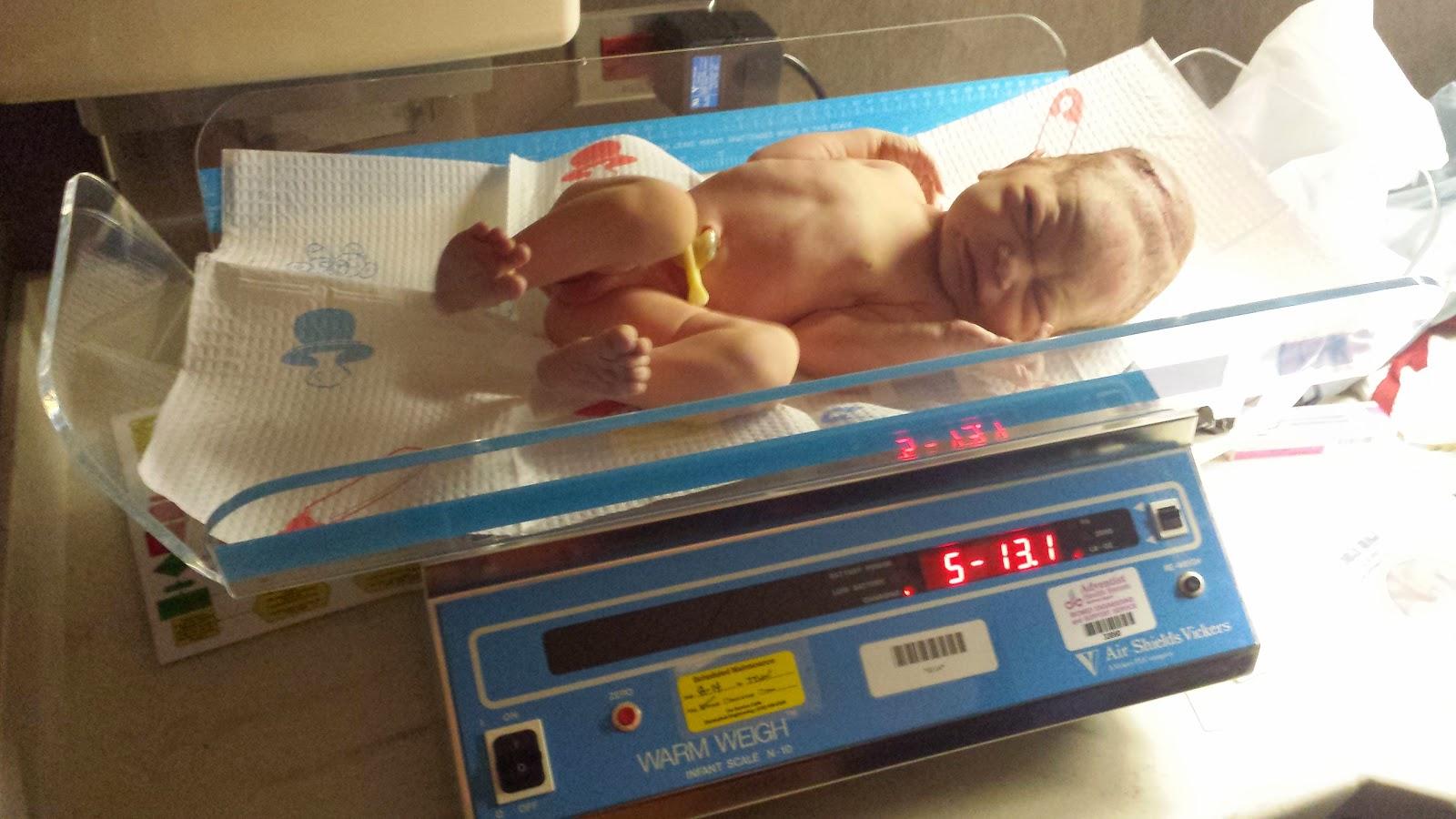
They were able to get her stable right there in the room, and, thank God in Heaven, and let me hold her for a few minutes before they took her to the NICU and got her started on her monitors and IV antibiotics. At the end of 27 hours of anxiety, determination, surrender, and plans being shot to hell, I was overwhelmed with thankfulness for modern medicine, pain medication, interventions, and highly-trained professionals who are compassionate, skilled, and empathic (let’s just forget about that first horrendous on-call OB). We survived. Les was a rock-star. My back-up back-up doula saved my sanity. And our feisty, skinny, wide-eyed little girl was worth every single second. 

Note her Cone-Head from the vacuum.

Body Talk

Several years ago, I read an Instagram post that of course I didn’t save, so I cannot give it proper attribution. But the gist of it was “Don’t talk to your kids about their bodies or about your body except to explain to them how bodies work.” I get the intent behind that idea. Don’t offer any commentary at all – positive or negative – about the way they, or we, or anyone looks. Keep body talk for health and hygiene and basic mechanics. 

But I’m starting to think about Body Talk with my daughter more like talking to her about sex. If I am not proactive, the world is going to fill her up for me. 

Just like with sex, our kids are going to be saturated with messages about their bodies and other people’s bodies. We don’t want to leave a void there – their peers and media and other adults will fill that void. We need to get out ahead of the body conversation.

Photo by Vadim B on Pexels.com

My typical M.O. is to wait for a “teachable moment”, like the one that happened on a rambling walk through the neighborhood this summer. 

My five year old daughter and I encountered one of our neighbor families as we strolled down our street. The three kids were riding their bikes to the park as the dad jogged along behind them. The oldest neighbor girl, Annie, is eleven years old. As my daughter and I walked home, my kiddo turned to me and asked “Mom, why is Annie fat?” 

Obviously, this smashed all my trigger buttons at once. My first impulse was to shriek “She’s not FAT!! We never talk about someone’s body!!”. But I paused just long enough to pull up scripts from some of the women who have written about raising body-neutral kids and tried this instead:

“Why do you say that Annie is fat?”

“Because she has a round tummy and it sticks out under her shirt.”

“Well, Annie is older than you, so her body is going to be bigger than you or your friends’ bodies. And, she’s right around the age where girls start to grow very quickly, and their bodies change from being like a little girl to looking more like a woman. Women are meant to have curvier, softer bodies than little girls.”

“Oh. Ok.”

“It’s OK to talk with me about these kinds of questions, but we should not talk to our friends about other people’s bodies, because it can really hurt people’s feelings.”

“Why?”

“Well, because some people tease people about how they look, or to say unkind things about other people’s bodies. And that hurts people’s feelings. We know that it is never OK to tease someone about how they look. People look different from one another, and that’s a good thing.”

“Right, because if everyone looked the same, we wouldn’t know who is who!”

“Right! Remember that All Bodies are Good Bodies.”

I desperately want us both to really believe that all bodies are good bodies. 

I don’t know how long I can “Fake It Till I Make It” as I teach my daughter body acceptance that I still struggle to absorb myself. My dear friend of over 20 years, Roxanne, and I had a conversation about all of this recently. She’s a momma of four, with one teenager already. They have been having Body Talks for years now. She encouraged me to be more transparent with my kiddo about my own struggles, and how hard it can be to love my own body and how easy it can be to judge other people’s bodies. 

Next time we have a conversation about bodies, I’ll tell my daughter that when I was younger, people teased me about my body. Even now that I’m a grown up, it is still hard for me to love my body. If she’s still listening, I’ll tell her how proud I am of my body for growing her and giving birth to her. I’ll tell her that I’m thankful that my body works well, and I don’t have any real pain or illness. 

I’ll remind her about how she is fearfully and wonderfully made – how we ALL are – no matter how we look or what our bodies do easily or struggle to do at all. 

I’ll tell her how people who want you to buy the things they are selling will tell you that you have to look a certain way to be happy, and I’ll tell her that that is a huge lie. 

My daughter saw me do the iconic Suck and Zip to put on some jeans the other day. I wonder if she has noticed that my body has gotten bigger over the past year. She hasn’t made any comments, but she notices everything. I started riding our stationary bike just about every day a few months ago and she asked me why. I told her it is because we’ve been indoors for so long, I haven’t gotten as much exercise as my body needs. I want to be strong and feel good, so I use the bike. That’s true, of course. Partly true. 

I’m living in the tension of body acceptance and wanting to be smaller. In the slogging murk of wanting to “be healthy” and “lose the pandemic weight” while trying not to give in to disordered eating and compulsive exercise. 

Here’s what I’m trying hard to absorb every day: It’s OK if I gained weight EVEN IF I never lose it. Even if this is just my middle aged, pandemic surviving, macchiato drinking body now. Bodies change. Bodies age. Yes, I do want to keep an eye on my blood pressure. Yes, I will create habits to move my body more because I want to still be moving when my kiddo is in high school and college (older mom problems). I want to get the gold stars at my next physical. And if I can fit back into my favorite dress by spring 2022, that would be great, too. 

Food Talk

My husband and I meal plan in hushed voices in the kitchen while our daughter watches Rescue Riders on her tablet. We’ve just recommitted ourselves to ratchet down our takeout habit and try to cook more actual meals at home, after a year of thrice weekly to-go splurges and a tight rotation of homemade nachos, frozen pizza, and packaged snack buffets for dinner. We’ve both had our annual physicals in the last couple of months, and were both rather shell shocked at the scale and our blood pressure stats. 

“We’ve got to get back on track. We have to set a better example. We are setting her up for failure if she starts to believe that this is the way to eat.”

“We want to be healthy and active and ready for fun with our kiddo for a long long time. We both want to get a handle on our blood pressures.”

“I do not want to buy even bigger pants.”

We whisper these nudges to each other and giggle, and I’m thankful that at least we have some solidarity as we endeavor to shore up our Pandemic snack food diet with some nutrients.

But we don’t want our daughter to overhear our food and diet talk. Even if we’re talking about adding in a lot of vegetables and shaking our dependence on processed food. Even if we’re not talking about calories or “junk food” or restriction. We don’t want her to hear us even talk in code about losing weight, or see either of us rub our bellies unconsciously when we draft up a grocery list. 

Food Talk is very fraught in our house. As with many parenting decisions, our choice to keep meal planning and weight gain conversations out of our daughter’s earshot are a direct reaction to the ways in which the food culture of our families set us up for lifelong struggles.

I grew up in a household where food rules were rigid in some ways and lax in other ways and meal times were often a battle. My mom was always on a diet. My dad made endless commentary on her food choices and how often any of us had dessert. We were a strict Clean Your Plate family, and the kids got little say in what went onto that plate. There were many nights that I sat crying at the table for hours, unwilling to swallow the requisite bites of canned peaches or creamed spinach. Those forced bites did not make me appreciate food, or learn to like things I despised. They just made me angry and resentful of my dad and full of anxiety every time I sat down to eat. I rejoiced every time I got to eat and my dad wasn’t watching. 

My family was rife with diet talk and confusing demands to eat everything served on my plate and also not to eat too much, lest I need a diet. My husband’s family was very different from mine, but had its own food angst. My husband’s mother grew up with extreme food insecurity, and that had reverberations into her own parenting, cooking, and eating expectations. We’re trying hard not to be like our parents in the food arena. It is much easier said than done. 

I have generally tried to shift the food conversation at home away from “junk” food or even healthy food vs. unhealthy food, but to notice and talk about how food makes us feel, and to talk about how much I enjoy eating a wide variety of foods and trying new recipes. It can be hard for a kid to make these connections, because the sugar rush is immediate but the hollow hunger of not eating filling foods happens hours later. It feels good and comforting to eat buttered noodles for dinner five out of seven nights a week. It’s hard for me to deny her the comfort and ease of eating things she loves, even if the list of entrees she loves includes only five items.  

Despite my adult frustration or even embarrassment that my kid is not an adventurous eater, she’s growing and has plenty of energy. How many adults tend to eat the same handful of “go-to” foods or recipes on repeat? I sure do. I spent at least three years in my 20s eating nothing but a rotation of six different Lean Cuisines for lunch at work. Nothing terrible happened. Kids feel, for the most part, just fine eating a steady diet of berries and carbs. 

Photo by Klaus Nielsen on Pexels.com

Author and journalist Virginia Sole-Smith writes about the Division of Responsibility in her book The Eating Instinct (highly recommend). Reading this strategy felt like a radical, risky, thrilling new world. The idea is that you, the adult, determine when, where, and what foods are served for snacks and meals, and the kid decides if she eats what you are offering and how much. 

If you’re thinking “my kid would just never eat anything I serve and would starve to death”, the caveat is that there is at least one thing you know your kiddo will eat at each eating opportunity. Kids determine what they put on their plates, and how much. No bribes, no coaxing. Sole-Smith encourages parents to be consistent, and once the pressure to try new foods is removed, and kids trust that they really can choose and eat as much or as little as they want from the choices you offer, the power struggle over food exploration is removed, and kids are more likely to try and enjoy new dishes.  

We have tried this a couple of times. It’s a bit of a hassle. It is easier to just heat up something on the list of her preferred entrees and make separate adult food. It’s easier to plop her plate of mom-chosen food in front of her. But every time I have tried the family-style buffet of options, my kiddo has surprised me by what she has chosen and how much she happily ate. Not always the “well balanced meal” I would like to see, but different from what I expected. 

Case study: veggie burgers. On a typical night in our house, I would prepare the veggie burgers for Les and me, and make some scrambled eggs and cut raw veggies and some crackers or tortilla chips onto a plate for my daughter. But one night, I put the buns in a basket, the pickles and condiments on the table, a plate of raw veggies, the burgers, and a bowl of mixed salad. She ate a bun, a pile of pickle slices, lots of raw veggies, and even tasted a leaf of red lettuce “just to see what the purple leaf tasted like”. She spit it out, but she tried it. And she ate her fill, and it wasn’t just a bowl of noodles and a yogurt cup. 

Leaning in to trust my kid is hard, because I don’t yet fully trust myself around food. We joke like this, don’t we? “I can’t let any cookies into my house or I will eat them all in one sitting”. Or we worry that if we don’t make dessert contingent upon eating an acceptable amount and array of food, our kids will just eat one green bean and a bagel and then expect a brownie. There are nights our kiddo eats only a few bites of food, even food she really likes, because she “needs to save room for dessert”. 

Here’s a radical idea that we are also testing at my house, at the suggestion of the same Virginia Sole-Smith’s Instagram conversations: Serve dessert alongside the dinner options, rather than at the end as an incentive. We tried it, and choked back comments when she ate the cookie first, but guess what? She went on to finish everything else she had decided to eat for dinner. No saving room. No bribery. Honestly, it made my husband and I both feel all kinds of ways. But why? If we agree that dessert is an option at dinnertime, and the goal is that she eats some typical dinner food, does it matter if she eats the dessert with her dinner rather than after? Especially if it frees her up to focus on the actual meal, rather than avoiding any whiff of fullness while eating the veggie dog and broccoli in front of her?

Is it easier for me to experiment with our family food culture because my kiddo is average size? Probably. Is it a huge pile of privilege to have so much flexibility in what we eat and serve and whether we all eat exactly the same thing? Absolutely. Do I still cringe with embarrassment and make excuses whenever we eat with others (I mean, hypothetically. We haven’t eaten with anyone in over a year) and my kid only eats a roll and a strawberry? Yes. 

On a good day, I can take a big step back and remind myself that I was a ridiculously “picky” kid, and now I happily eat all kinds of things I never would have touched when I was six. And on really great days, I remember that my kid is her own person with her own preferences, and I can toss her a multivitamin and not take it personally that she doesn’t like to eat many of the same things I like. A lot of you probably wouldn’t like most of the staples of my gluten free, mostly vegetarian, tofu-heavy diet. I don’t take that personally. We can still be friends.

Turkey Jerky

Last night, I sat alone in my Subaru Outback in the Trader Joe’s parking lot and wolfed down a CHOMPS Turkey Jerky stick before starting the engine and driving home to my family. That is only remarkable because I have been a vegetarian for 17 of the last 19 years. 

I have also been hungry most of every day of the eight years since I cut gluten out of my diet. I’ve been hungry while I have steadily gained weight. I was fairly content in my meat free life so long as I could tuck into a steaming bowl of pasta or tear my incisors through a crusty hunk of sourdough. I gave myself a two year break from vegetarianism while my mom was sick and I did a lot of eating in my car on my drives back and forth to her house and took up long distance running to keep myself on the rails. I got back on the plant-centric bandwagon when I met my husband, who was eating vegan when we met. We agreed to meet in the middle and keep a vegetarian household when we got married. Even the dog we adopted ate vet-approved home-cooked vegetarian dog food made from quinoa, egg, peas, cheese, and doggie vitamin powder.

Then eight years ago I found myself on a cold gurney counting backwards from 10 as the anesthesiologist knocked me out for my first colonoscopy. My guts were very, very angry, and given the aggressive colon cancer attack my mom fought unsuccessfully in her 50s, the gastroenterologist insisted on a full scope of my large intestines. He discovered that my colon was kinked like a hose in two places, which was clearly causing the alternating constipation/diarrhea I had lived with for years. I had literally tied myself in knots. 

The colonoscopy procedure itself unkinked my struggling plumbing and I felt better immediately. And then a few weeks later, the cramping and bloating and gas returned. I decided to try the elimination diet my PCP had urged me to consider before my colonoscopy and discovered a clear connection between eating wheat and my lingering embarrassing digestive trouble. The longer I abstained from gluten, the better I felt. My cystic acne disappeared, and I stopped having the spontaneous nose bleeds I had chalked up to seasonal allergies. My belly pooch flattened out, and I didn’t need to duck into the bathroom at work multiple times a day to privately relieve the gas ballooning inside me. I felt great, except for the fact that the texture of most gluten free baked goods closely resembles that of a damp kitchen sponge, and are just as filling. 

I eliminated meat from my diet out of a sense of duty to my worldview. I wanted to withdraw my financial support of the hellscape of factory farming. I relieved the cognitive dissonance of crying over news stories about boat-maimed manatees while noshing on a turkey panini. The decision to be vegetarian felt great, even if I really longed to be vegan and really “go all in”. I was too lazy to commit to that, and too addicted to cheese. Vegetarianism felt sustainable. I believed it was something I could maintain for the rest of my life. I allowed myself a couple of passes per year to try a bite of something meaty when offered or to order a fish dish when at a restaurant or wedding whenever the only vegetarian option was eggplant parmesan. I realized quickly that the Vegetarian Police were not going to roll up in their squad cars and publicly humiliate me for a bite of animal flesh. 

Which brings us back to the turkey jerky. 

Intuitive eating is all about learning to recognize our hunger and satiety cues and respond thoughtfully. I have grown so accustomed to living with gnawing hunger, I barely even register the sensation anymore. I’m hungry right now as I type this, despite a hearty portion of gluten free pasta with goat cheese, tomato, and arugula for lunch. I was hungry last night when I shopped for the ingredients for said pasta dish, and I sheepishly grabbed a turkey jerky strip and threw it in the cart. I don’t think there is anything magical about meat protein versus vegetable protein. I’m sure there are plenty of people who are doing just fine on plant based diets. I just don’t love meal planning or cooking enough to be as diligent as I am finding I need to be to feel full on plants. Most of my meals are rice or corn-based starch plus vegetable plus cheese. Sometimes beans or lentils. Sometimes soy or tofu. Occasionally vegetarian meat substitute. I fear that if I really eat every time I am hungry, I will expand to an unacceptable size. For the past eight years, I’ve decided to limit myself to working with the current fandeck of vegetarian, gluten free ingredients, and so I have just accepted the fact that I will almost never feel full. 

Here’s the thing about committing to a food restriction as part of your identity: It is really really complicated to change. Even acquaintances at work know I am vegetarian. Some of my relationships were forged around a shared commitment to a meat free life. My daughter is aghast that anyone would kill and eat an animal, and regularly interrogates people about whether they eat meat, and if so, why they think it is OK to eat animals. She has known that “we don’t eat animals in our family” since she was old enough to inquire about what other people were eating, or why we always steered the shopping cart in a wide arc away from the butcher counter at the grocery store. She has seen her relatives carve slabs of prime rib and pull wishbones out of turkey carcasses and has voluntarily opted out, even when offered a taste of salmon or grilled chicken at grandma’s. She knows that we have to repeat our speciality order at the McDonald’s drive through multiple times to make sure she doesn’t end up with beef: “Cheeseburger Happy Meal, no meat. Just bun and cheese – like a grilled cheese”. “WE DON’T EAT ANIMALS!” she screams from the carseat. 

We don’t. Not often, anyway. But here I am, wondering if a weekly wild-caught salmon dinner or so-called “humanely raised” turkey slices would quiet my roaring stomach. If it’s worth the karmic guilt. If I could really just get my act together and cook all the beans and lentils and tofu. There are turkey slices hanging out in the fridge, daring me to eat with abandon for a little while and see what happens.

Sunday Comment Roundup

You Guyssssssssss!!

Your comments this week about my posts and Instagram questions have been SO GOOD. So good. I am so thankful for each of you. Your willingness to be open and vulnerable about our very personal and often fraught relationships with food and eating and diet culture has been motivating and humbling. I wanted to share some of the comments I received, anonymously, in case you see any of your own twisty, bunchy, scratchy eating-stuff (or calm and balanced approaches!) in any of these experiences.

Here is how some of you replied to my prompt about whether you remember your mom dieting as a kid, and if so, how food was talked about in your home growing up:

  • “I think I always wished they noticed something about me besides that I ate the food in front of me.”
  • “I remember relatives commenting how “the Smith* girls are always clean platers!” *not their real name.
  • “Portion control!”
  • “I don’t remember diet, but remember lots of unhappiness with how mom felt about how she looked. No shorts, no bathing suits.”
  • “We strived for balance in meals, not a lot of soda/packaged snacks; eating together as a family, having treats when out sometimes but later in life when the fat craze was happening, it was about eating more of those to replace other things (we know better now, but didn’t like the rest of America at the time).”
  • “My mom dieted. I specifically remember her using Slim Fast shakes and bars. She was also a dietician…”
  • “Mom once told me she felt accomplished if she went to bed hungry.”
  • “My family went through feast and famine. Grandma or the church would roll up w groceries.”
  • “She started Jazzercise at age 40 and really cut out sugar, fried foods, etc. I feel like she did it correctly!”
  • “I can’t even fit that can of worms in this box.”

I’ve also heard from several of you via calls and text messages with longer stories and examples of your childhood food life and how that has bubbled over into your adult eating habits. And a couple of you called me after my post about my doctor’s appointment to share your experiences with your doctor, or the experiences of a spouse or other family member.

And one of you, after reading my post about my doctor’s appointment, texted me this:

“I’m glad she [my doctor] could show you God’s love for your body today.”

Which reduced me to a blubbering pile of sobs. Whooo-boy. There’s a lot to unpack there. (Thanks, decades of “our bodies are inherently sinful and our “fleshly desires” will pull us into all manner of disobedience” teaching). I’m not even going to touch that today, except to say that it has been a trip to think about all the ways growing up in conservative Protestant churches have shaped my body image and conception of food and eating. Book project?

THANK YOU, friends. I’m grateful for you. Let’s keep talking and thinking and unpacking, shall we?

Photo by Pixabay on Pexels.com

I was hoping for at least a little shame.

Lest anyone think I am on the cusp of full, healthy self-acceptance, let me give you a peek at some of the miasmic content of my inner life.

My annual physical was today, except I haven’t been so stellar on the “annual” part. I thought I had, but my official records show that the last time I went in for a well visit was in March of 2018. Whoopsy!

In anticipation of today’ visit, I steeled myself for the “I-have-your-best-interests-at-heart” beat down I was expecting from my primary care doctor when she and I got to the part about my current weight. I imagined her concern about the number on the chart, especially relative to the 2018 number, and rehearsed my response to her prescription for weight loss with some subtle fear/shame drizzled over the top for full effect.

In these mental rehearsals of my doctor’s imaginary scolding, I envisioned that I would stack her comments in a neat crisscross pattern, whip out the Queen of Hearts Zippo lighter given to me by a roommate 15 years ago, and ignite the bonfire of food restriction and punishing exercise I planned to enact immediately.

“Well, I have to do it, you know. For my health. Doctor’s orders.”

Photo by Min An on Pexels.com

Here’s the thing though. She didn’t mention it. Not one syllable about my weight. I have an amazing PCP who is actually not perpetuating weight stigma or diet culture, and there I was, disappointed. We got all the way to the end of the check up and I started to panic. Was I not going to get my hall pass back to orthorexia? How was I going to get the validation I wanted to take extreme measures to shrink my body if my doctor wasn’t going to give it to me?

As the appointment was wrapping up, she asked me if I had any health concerns, and I blurted out “This is the biggest I’ve ever been and I’m kind of freaking out about my weight gain. I don’t feel like my eating habits have changed much. I’m afraid I’m going to gain more weight.”

Do you know what she did? Could you even believe me if I told you?

  • She normalized weight gain during a global pandemic. “Many people have put on weight this year. Stress can really contribute to weight gain, even if your diet hasn’t changed.”
  • She normalized people’s bodies changing over time. “As women slide through those last ten years leading up to menopause, our metabolism changes dramatically. Our bodies technically need fewer calories as we come out of our child bearing years. Many women notice weight changes in their 40s.”
  • She validated my concerns about my health. “We’re going to run blood work, and we’ll look at your thyroid and your blood sugar and other markers. Your previous blood work has always come back fine. If we see something amiss this time, we can make adjustments. If you feel like you want to lose weight, we can talk about that.”
  • She carefully advised against dramatic calorie restriction. “Your body needs fewer calories as you age, but it’s difficult to feel satisfied on a restricted diet. Finding exercise or a sport that you enjoy and ramping up your time moving is a more sustainable approach. Eat food you truly enjoy, and try to avoid eating or drinking things out of boredom, or things you don’t actually enjoy eating.”
  • She didn’t even breathe the letters “BMI”. She didn’t print out handouts about weight loss. She didn’t remind me of risk factors for diabetes or cancer or heart disease. She did show me the fitness app she uses for body-weight-resistance strength training “You don’t need any special equipment! And weight training is good for your bones!”.

My doctor did all the things I know so many people want and need their doctor to say to them. She focused on my actual overall health (bloodwork, how I am feeling in this body of mine, my mental health in this train wreck of a year) rather than one number. From what I have been reading, I know this is not the norm. I am thankful for my very English, very proper, very weight-neutral doctor. I am also thrown for a loop. If I’m not motivated by fear and body shame, I guess I’ll just have to be motivated by the endorphins of exercise and the pleasure of eating what I truly enjoy? I am honestly not sure I know how to do that.