I want to leave Diet Culture for good. I also want “healthy food” to save me.

 This is an excerpt from the essay I wrote and workshopped in my writing class this summer. It is the foundation essay to the essay collection I hope to finish and publish.

I didn’t know my mother kept a diary. I discovered it in a stack of books perched on the crowded nightstand in the upstairs bedroom of her house. A bedroom she had not been able to reach for months, her body unable to summit the staircase. She had been living entirely on the first floor the year before she died, and she had been dead for over a year when I found the diary. My siblings and I had finally started to clean out the house that she and my dad had built together; sorting 30 years of life into Dumpster, Donate, Sell, Keep. 

My sister sat on the floor in front of a heap of wrinkled clothes she had pulled from mom’s dark brown carved-wood dresser. “I think this is mom’s diary. What should I do with it?” I handed my sister the purple hard-back, but she waved it away without looking up. “Don’t read that, Jill. It’s private.” I wordlessly tossed it onto the bed beside me and moved on to the rest of the stack. When my sister dragged a white garbage bag full of stained t-shirts and snagged hosiery to the dumpster, I lurched for the book and sat down on the floor with my back against her bed. The blood throbbed in my ears as I cracked open the spine and leafed through the entries. The daughter reading her mom’s diary, hands sweaty, expecting to find notes about her marriage or my dad’s illness and death, or my meddling grandparents, or me or my siblings. I expected her diary to look like mine – chronicles of heartbreaks and everything I couldn’t say out loud, with a few private joys woven in to hold it together. Waves of grief, guilt and curiosity trembled through me as I flipped through the pages. There were only twenty or so entries spanning over a decade. None were more than a paragraph long.

Please, God, help me lose some weight. I don’t want to be like this anymore.

Went to Weight Watchers tonight. It feels more doable this time. They’ve changed their program since the last time I tried.

Shortly after she completed her chemo she wrote: 

Well, the Lord works in mysterious ways. All those years asking God to help me lose weight. Looks like the chemo has finally helped with that! Be careful what you wish for.

Nearly every entry was about her weight or her body shame or a new diet she was trying. Prayers scribbled in exhausted script. “Please, God, help me have some self-control. Please, God, help me lose some weight.” My dear mom had suffered so much, and the only griefs spilled into her diary were sorrows over her weight and failed diets. My heart tore wide open and I gulped back a sob. The sharp sting of this breach of her privacy compelled me to run the book out to the rust-orange dumpster and hurl her secrets over the container’s wall into the tangle of broken lawn chairs and mouse-chewed craft supplies. I never told either of my siblings what I had read.

I never thought of my mom as “fat” when I was growing up. She was soft and mom-sized. She shopped for clothes in the plus section but seemed to me to be similar in size to many of her peer moms. She was always on a diet. Weight Watchers, Slim Fast, Bible-based diets, soup and Special K diets. She never really lost any weight. My dad made relentless commentary about what she cooked and ate. 

Do you really think you need seconds?

None of us really need dessert every night, you know.

Is that on your diet?

I saw the pain in her eyes even though she never retorted. “Probably not” she’d sigh. 

My dad was dying, slowly, of Type 1 diabetes, which is the type that has nothing to do with how much you weigh or brought about by what you eat but is rather a ruthless genetic glitch. He had been managing the disease with a strictly sugar-free diet and daily insulin injections since he was five years old. He was also taking lithium for bi-polar disorder, which was still called Manic Depression in the 80s. His life depended upon careful label reading and strict sugar avoidance. He lived on meat, baked potatoes and Diet Coke. He occasionally indulged in strawberries or a swig of beer when his brothers were in town, but only if he was at home where he could check his blood sugar and stab another hit of insulin if needed. 

When I was 14, he was let go from his job as a computer systems analyst because he couldn’t physically sit at a desk all day or type. Diabetic neuropathy in his fingers made it impossible to feel the keys of his keyboard. He was eventually granted permanent disability and stayed home all day for the next nine years, propped up in his brown faux leather recliner at first, and eventually a home hospital bed. By the time I was 18, he had only five modes: sleeping, yelling, laughing, crying, or watching M.A.S.H.

His comments to mom were, I believe, rooted in love and concern for her but mixed with vanity, jealousy over an abandon with food he had never experienced, and full buy-in to patriarchal, capitalist norms about what a woman’s body is allowed to look like. He was a good man, addled by disease and mental illness. He was a good man, who policed my mother’s food intake and bemoaned her inability to return to her svelte pre-baby body.

I’ve gained fifteen pounds since my daughter was born five years ago. Fifteen new pounds since the round-the-clock breastfeeding of a struggling newborn and the bleary nineteen months of sleeplessness that followed as my babe woke every two hours to eat. I had to oblige her. “She’s right at the edge of falling off the growth curve” her pediatrician told me. “You can switch to formula if it’s too much for your body”. I did supplement with formula, but kept drawing her to my breast, over and over, throughout the long nights. The lactation consultant didn’t find anything amiss with my breastmilk, or her latch. “She’s just tiny. She can only hold so much at a time in that tiny tummy”. She all but refused to eat solids, so I felt compelled to keep going despite the crushing exhaustion. She needs it. She’s so small. And also, feeding a hungry human from your body burns a shit ton of calories. I felt free to eat almost anything I wanted. 

The medical establishment concludes that the “typical Western diet”, obesity, and low levels of exercise all increase your risk factor of developing colon cancer. I can’t “get” Type 1 diabetes, but because my dad had Type 1 and my grandmother had Type 2, I am at higher risk for Type 2, which is commonly believed to have a strong link to obesity and visceral fat that pads your organs around the waist. I’m predisposed to at least two lethal diseases whose trigger seems to have at least something to do with what you choose to eat. On the other hand, years of data shouted by the anti-diet, body positivity folks say that diets don’t work, almost always do more harm than good, and that weight has less of a correlation with health than the patriarchy wants you to believe. The conflicting science haunts every grocery list, every meal plan, every daily decision about what to put in my mouth. 

My new fifteen pounds snuck up on me over the last three years because I kept eating whatever I wanted even after I stopped breastfeeding. My husband doesn’t comment on my weight or what I choose to eat, but despair over the soft cushion of my middle keeps me awake at night. I read anti-diet-culture manifestos and try to buy into intuitive eating and body positivity. Every day, I hold up the genuine urgency of accepting my body and setting a better example for my daughter and weigh it against the deep, deep fear of succumbing to the colon cancer that took my 59 year old mother while I still desperately needed her, or the diabetes complications that ultimately took my dad at 51. I want to confidently stake my tent in the anti-diet and body positivity camp, but I never get there. The tangle of fear at my feet trips me. What if the medical establishment is right? What if the unbridled bloom of my belly triggers a deadly disease? What if my lack of self-control leaves my young daughter motherless? What if there is a limit to my husband’s solidarity with my self-acceptance? What if I, like my mother, just don’t want to look like this anymore? If I get a terrible disease that I could have prevented, all eyes will be on my waistline. I want to love my body, but I also want to control it.

I am the unbeliever who lies awake at night, worried that she might be wrong about hell.
Pandemic Puppy

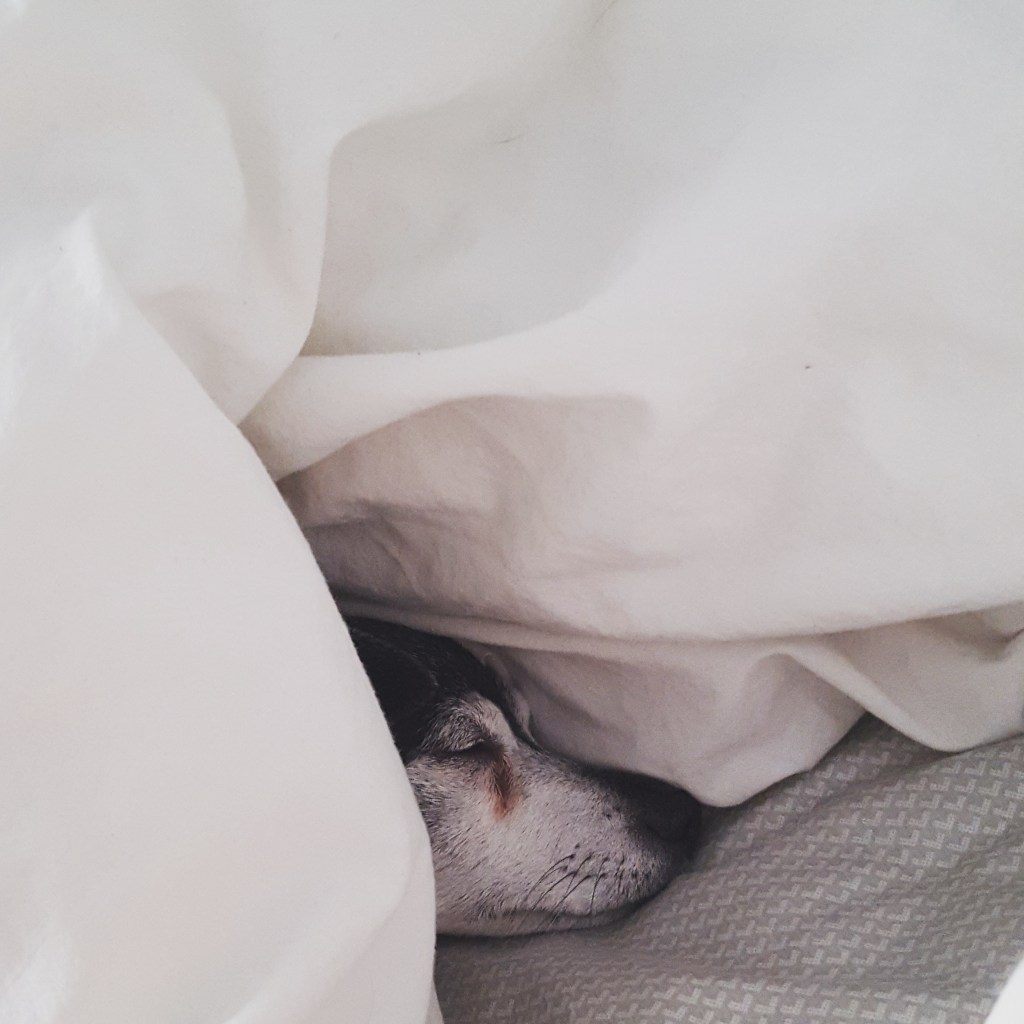
I originally wrote this post in August of 2020, when Daisy was still a baby. A lot of things have gotten easier since then. As of this posting, she only occasionally destroys clothing while you are wearing it.

Our beloved Chihuahua/Rat Terrier mix, Auggie, died in June at the age of at least 15, after a short but brutal decline from brain stem cancer. He hated all but a pawful of people, and that small group of acceptable humans did not include our five year old daughter. Dogs were not really Auggie’s jam, either. He was friendly with exactly one dog in his ten years with us; a little dachshund who lived around the corner from our Roger’s Park apartment. She and Auggie would shyly bump noses and wag tails at each other and he seemed as smitten as an ornery old dog could be. He thought the rest of the dogs in the universe could go jump in a lake. 

We were childless when we adopted Auggie. He was an adult dog with an epilepsy diagnosis and twice daily medication when we brought him home. We joked that he was our fur-baby, which was an eye-roll type joke to our friends, and, privately, not at all a joke to us. He was small and kind of fragile. He needed us. He had been adoptable for months when we saw his enormous upright ears on Petfinder and drove over to Red Door Animal Shelter to pick him up. “Most people are not interested in a dog that they know has any kind of medical issue” the adoption counselor told us. “But this little guy will probably have a pretty normal life once he has the right meds and follow up care.” 

We took him to vet appointments and adjusted his anti-seizure meds. We hired trainers to help us and him with his anxious habits. We worked on creating a zen-like home environment for him. Our needy, anti-social little dog stretched our hearts wide open when we were pretty sure human children were not in the cards for us.  

We loved him for 10 years, my husband especially. He liked to snuggle in between our thighs on the couch and purr-snore his way through our Netflix binges. He loved to sleep on Les’s lap while he graded papers or tapped with furious energy into his laptop to finish his dissertation or surmount the next pinnacle of his latest writing project. Auggie loved to sleep, snuggle with me or Les, and sometimes sniff around the yard for rabbit poop he could gulp down like candy. He didn’t like walks or fetch or toys or kids. In his sunset years, we indulged him with the gift of never having to eliminate outside ever again – he had two generous dog potty pads in the corner of the kitchen and used his “litter box” faithfully to the end. He was a cat in dog’s clothing. 

Auggie Doggie

After he died, I caught puppy fever. Ok, before. It seemed like at least a quarter of the people we knew had gotten a puppy since the shutdown, even people who had never struck me as “dog people”. How hard could it be? And, I mean, have you ever seen a puppy? Don’t you think that puppy licks and galumping sprints through the backyard and snoring couch snuggles could go a long way to heal the big dog-shaped hole in our family? Wouldn’t a puppy give our days structure and focus and our family a group project? Training, walking, housebreaking, playing. Those all sound better than the endless, boundaryless stream of days and weeks and months we have had since last March. It would force us to keep the house clean so the puppy wouldn’t swallow a lego or eat our books. We would eat dinner at the dining room table again, rather than sprawled out on the couch, each with our own device, ignoring one another for a few blissful minutes of mouth-stuffed alone-ish time. (Is that just us? Months of 24-7 togetherness have made “Let’s sit down to a meal together!” seem like overkill).   

It wasn’t just me. Within days of Auggie’s death, our daughter’s doggy love escalated quickly to a dog obsession. Our daily walks around the neighborhood were timed for the maximum likelihood of encountering people walking dogs. She knew every dog in every fenced yard between our house and the park. She unabashedly begged people to let her play with their dogs. “I could come in your yard right now, or I could come after The Sick and play with her in your house!”. She convinced our brand new next door neighbors to let her come to their yard and run and roughhouse with their two young dogs. I watched her squeal with delight as they zoomed past her, ran circles around her, and licked her hands and face. 

“Wouldn’t P do better with a doggy playmate? She’s an only child! She’s so lonely!” My husband, still heartsick over Auggie, leaned ever so slightly towards agreeing. I ran through that narrowly open door and started sending in dog adoption applications all over the region. My heart was set on a puppy, but I knew those were in high demand, and we had always been inclined towards those hard-luck pups who had been on the adoption rolls for a long time. So I applied for some adult dogs, too. I had heard that the pandemic had dramatically increased demand for adoptable dogs, and in fact several of our local rescues either had no dogs available, or had set up a (brilliant) fundraising effort where you could make a nominal donation to get “first dibs” on new dogs as they became available. It felt like the odds were stacked against us, but we were happy in the knowledge that record numbers of dogs were finding homes, and full of empathy for shelter workers (most working tirelessly as volunteers) who were totally unprepared by the deluge of dog demand wrought by thousands of home-bound people eager for companionship and drowning in time away from their routine. I was shocked when I heard back from one of the first and most earnest applications I sent – I had a serious puppy crush on one of the black and white lab/hound mixes on the Safe Haven website.

Would a puppy be more work than an adult dog? Sure. Was I ready for the challenge? I absolutely thought so. My biological clock screamed over my logical brain on this one. You see, I’m 42 and we did not intend to have just one child. This year, my baby-wanting whipped me into a frenzy, but not quite enough to pursue any medical interventions. Just enough to wish it would JUST HAPPEN ALREADY. And stick. After two miscarriages, I radiate pregnancy ambivalence. I want another child. I do not *actually* want to be pregnant or give birth again. At my age, it’s really unlikely to Just Happen. But there was this steady thumping of desire – for baby snuggles and baby coos and baby clothes and baby wearing. For a sibling for our brilliant goofball of a daughter. A desire to mother something. I’ve gone from “mommy” to just “mom” over the span of a couple of harrowing months, and it is jarring. Anyway. A puppy seemed like the next best thing. “Bringing home a puppy is a lot like bringing home a newborn!” the rescue agency adoption coordinator told me over the phone while conducting our screening interview. “Perrrrrfeecccttt” I whispered to myself. 

But holy shit. It is not perfect. For one thing, newborns will, at least 92% of the time, poop and pee in one predictable place: a diaper. Also, newborns don’t ambush and pounce on their older sibling with all their baby energy and shark-like biting power. Newborns don’t chew on your walls or your storage baskets or your hands or your daughter or tear holes in all your shirts while playing tug of war with the clothes you are wearing on your body. Newborns CAN accidentally ingest dangerous objects. They just can’t bite off and swallow chunks of, say, tree trunks or dead animals or toxic toadstools or underpants. Newborns, for the most part, can’t weasel between your legs at the front door and run into traffic. No, this is not like having a newborn. It’s more like having a toddler with really sharp teeth. The only ways in which this puppy is easier than a newborn or a toddler is that 1) the puppy sleeps about 7 hours straight each night before needing a pre-dawn potty break (contrast with my human child, who was 19 months and 21 days old the first time she slept more than three consecutive hours at night) and 2) I am not breast feeding this puppy. 

I am suffering the natural consequences of my selfishness in wanting a puppy when they are in such high demand: the pulsing headache of baby fever drove me to toss all that empathy for hard-to-home dogs out the window to GET A BABY THING. And now that baby thing is destroying our house. 

But P adores her, even when the licking turns to nipping and the nipping begets tears. And Les dotes on her and thinks she is absolutely the right dog for our family. He reminds me that perhaps my expectations were too high for her, and notes that all ages of dogs are in high demand right now. The fact that we were even matched with this pup seems like a sign. I applied for six dogs, and only ever heard back about this pup. And she is really freaking cute. After our 5 am potty break in the yard, she and I lumber bleary eyed back into the house and I sprawl out on the couch to try to get a little more sleep before I start the day. She stretches her sleek black otter-like body over my torso and nestles her face under my chin and we snooze. The endorphins or hormones or whatever this cuddling produces are the fairy dust that sparkle away the angst of the previous day, and the early wake up, and my dread of more holes in more clothing and more emergency vet  X-rays for foreign objects and the exhaustion of a demanding house training routine that seems to be only 40% effective. In those minutes before the day officially begins, she is my fur baby, and we are alone together in quiet and dark, learning together how to recalibrate our family dynamic and commit to the long game. Babies don’t keep. Thank heavens. Now that we’ve had both a puppy and a human newborn, I will tell you that the puppy is harder.*

*Except for the part when I didn’t get any REM sleep for 2 years with the human baby.

Between 2 – 15% Risk

I schedule my annual mammogram and annual physical for the week of my birthday so I won’t forget to present myself to the medical establishment every year for inspection. I went for my first mammogram right after my 40th birthday, so today was my third time at the outpatient imaging center for a breast exam. I am all for every kind of screening, image, blood test – anything a doctor will give me to keep an eye on this cunning body of mine. I have this nagging suspicion that there is always a secret coup simmering below my epidermis. Whispers and encrypted messages are being sent along my neurons, my cells just waiting for me to start watching Bridgerton again so they can take advantage of my distraction and initiate a violent overthrow.

I sat in a chair in front of a drafty tinted window, wrapped in my watermelon pink medical gown, arms snaked around my torso to keep from freezing. I answered all the pre-mammo questions: Family history of breast cancer? No. Could I be pregnant? No. How old was I wen I had my first period? 12. How many full term pregnancies? One. A couple of questions about my ethnic heritage and my cycle and my nipples, and the mammography technician swivels on her stool to look at me and asks “Do you want me to click this button to calculate your current and future risk for breast cancer, based on your responses?”

DO I?

Do I want to know? They’ve never asked me this before. I was totally unprepared for this Magic 8 Ball moment.

“Yes” I blurt out.

“Ok, the computer says you have a 2.14% chance of having breast cancer right now, and a 15% chance of developing breast cancer in your life time.”

“I’ll take it.”

“You’re considered low risk.”

“Great!”

The mammogram process itself was uneventful and cold and squashy, as always. A few hours later I had a new message in MyChart to let me know that the radiologist had read my images and my breasts looked healthy and to come back next year. Terrific! It won’t be the breasts to lead the mutiny this year!

Next up, I’m due for a colonoscopy in 2021. Since my mom’s colon cancer was so aggressive, I’m on an Every Three Years schedule. I’ll ask my primary care doctor at my physical next week if I should go ahead and schedule it, or wait until the post-COVID pax romana we are all eagerly anticipating. Colonoscopies themselves are not bad – you’re out cold for the whole thing. It’s the prep and the immediate aftermath that can be unseemly. But I would sign up for a colonoscopy as often as they’ll give them to me if it means catching a polyp before it breaches my large intestine.

Get your mammogram. Ask if you can just mix Miralax into your favorite sports drink rather than using the nasty standard colonoscopy prep mix. And remember to love your body enough to check in on it regularly. Check in on your body like you would check on your kid who has been playing quietly in her room alone for a while. She’s almost certainly building an elaborate chateau out of Lego bricks and toilet paper rolls, but she may have just started painting your puppy and the walls with nail polish. Just go check.